Alabama Termite Identification & Mapping
Found termites in Alabama? We provide free termite identification for samples collected in Alabama. Your sample can also help document termite distributions across the state.
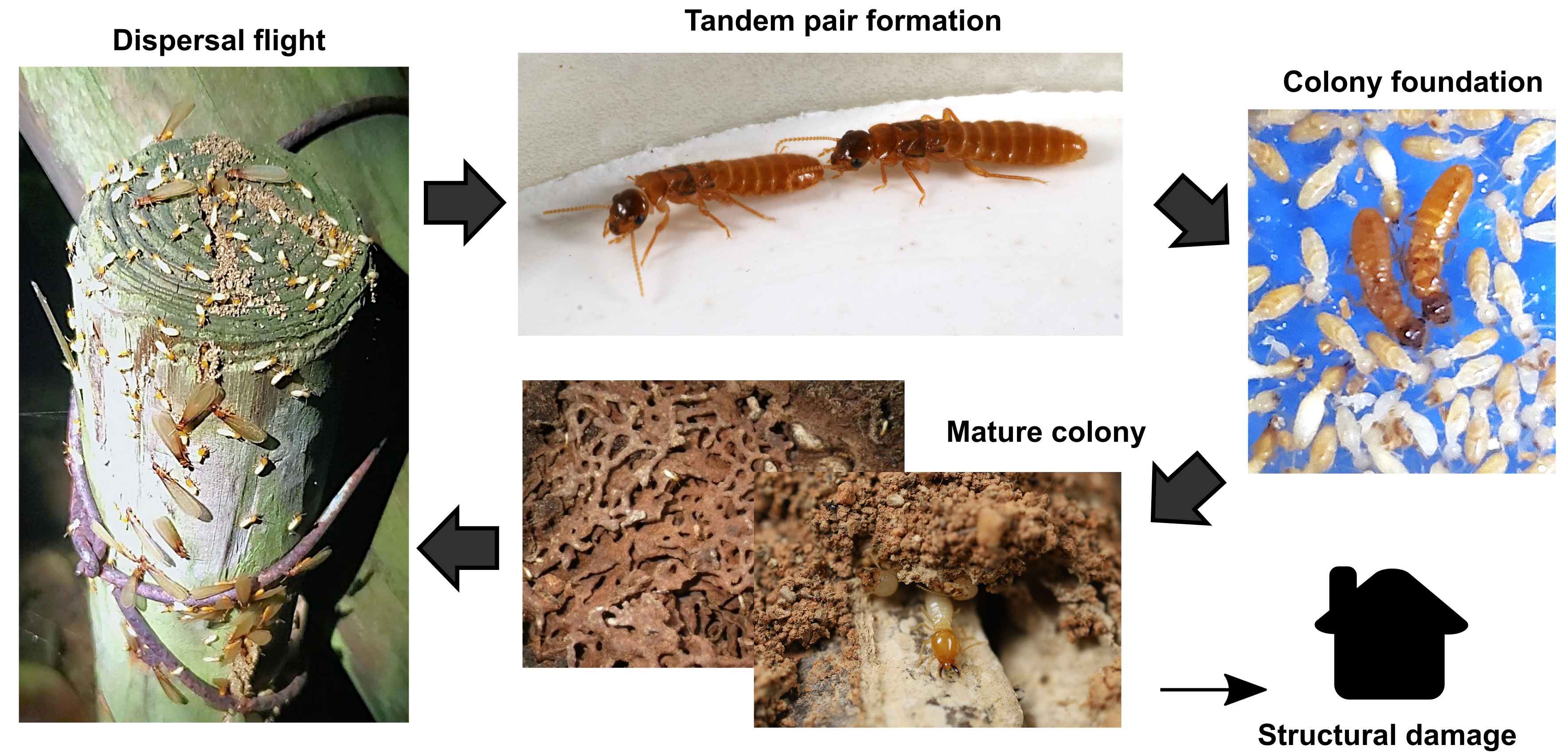
The Mizumoto Lab at Auburn University, in collaboration with the Auburn Plant Diagnostic Lab, identifies submitted termite samples at no cost and uses verified records to improve our understanding of termite diversity and distributions across Alabama.
Termite colonies begin when winged reproductives disperse, find mates, and establish new colonies. Different termite species differ in their distributions, biology, and importance as structural pests, so knowing the species helps us understand both termite diversity and termite threats in Alabama.
Free termite identification
Termite identification is provided at no cost. Choose the submission route that best fits your situation.
1. Identification request
This route is appropriate for homeowners, Extension personnel, pest management professionals, and other occasional submitters.
- Open the Plant Diagnostic Lab Forms page and complete the Insect Identification Record Form.
- Write your email address clearly on the form, because the current form does not have a dedicated email field and termite identification results are provided by email.
- Include the completed form with the termite sample and mail it to:
Auburn Plant Diagnostic Lab
Attention: Meredith Shrader
ALFA Agricultural Services and Research Bldg.
961 S. Donahue Dr.
Auburn, AL 36849-5624
2. Repeated or bulk record submissions
For repeated or bulk submissions, you may mail samples directly to the Mizumoto Lab. No specific submission form or spreadsheet is required.
Mizumoto Lab
305 W. Samford Ave.
AG STEM, Room 3203
Auburn, AL 36849
Every submitted specimen will still be identified at no cost, and results will be returned by email. For multiple samples, please give each container a unique label and provide the collection information for each sample.
Sample and information requirements
Collect several termites. Please include soldiers or winged termites (alates/swarmers), because these are essential for reliable species identification.
Place the termites in a small, sturdy, tightly sealed container. Do not mail loose termites in an envelope.
For each sample, provide:
- Collector and/or submitter name
- Email address
- Collection date
- Exact collection location (street address or coordinates)
- Your tentative identification, if you have one
We can provide an identification only when we receive a physical termite sample with the required contact and collection information. We do not confirm identifications by phone. Results are provided by email so that both the submitter and our team have a clear record.
Your sample contributes to a statewide picture

Eligible identified samples may be added to the Alabama Termite Map. Exact specimen locations are not displayed publicly. Before publication, coordinates are generalized by up to 300 m to protect the privacy of collection locations.
The public map brings together verified specimens, published records, and other biodiversity data to document native termite diversity and monitor invasive species in Alabama. It is intended for homeowners, pest management professionals, Extension personnel, and researchers who want to see which termite species have been documented in different parts of the state.
Some counties are shaded because the Formosan subterranean termite has been documented there in published historical records. These are county-level records, not specimen locations. A shaded county may therefore appear even when no preserved AU specimen point is currently available from that county. We especially welcome new submissions that can improve specimen coverage in these areas.
A mapped record shows that a termite species was documented in an area at some point. It does not mean that a particular property currently has an active infestation.
Submitted specimens help build a record of termite diversity in Alabama. Eligible specimens will be deposited in the Auburn University Museum of Natural History (AUMNH), where they can support future research and education.
Partners and related programs
This effort is a partnership with the Auburn Plant Diagnostic Lab, and the Auburn University Museum of Natural History (AUMNH).
The program was inspired by the UF/IFAS termite distribution and identification program. We also participate in the North American Termite Survey (NATS), a collaborative effort to improve knowledge of termite distributions in North America.
This program is supported in part by NSF Award 2611846.